Alexander Bogen
 Alexander Bogen / Testimony
Interviewer: Michal Sternin, Merav Jano - Yad Vashem [Hebrew]
Alexander Bogen was born in Dorf Estonia in 1916, to the Katzenbogen family. When he was one year old, his family moved to Vilna. Bogen studied painting and sculpting in the Faculty of the Arts at Vilna University. After Lithuania was captured by the Nazis, he joined a partisan unit at Naroch Forest and infiltrated the Vilna Ghetto shortly before its liquidation. In the ghetto, Bogen joined the FPO (Yiddish: The Fareynikte Partizaner Organizatsye and in English - The United Partisan Organization), organized and smuggled groups of people from the ghetto to the forests where they joined non-Jewish partisans. Bogen commanded one of the units who went on missions to lay mines on railroad tracks, sabotage German armories and distribute information about the mass murder that was taking place. While taking part in the missions, Bogen drew the places, the people, and the events around him.
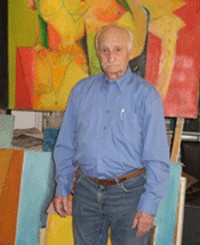
We met Alexander Bogen in the studio next to his house in Tel Aviv. The studio is full of paintings and drawings from different periods in his life: some from his time spent studying at the Vilna Academy, a few left from the war period, and some from his years living in Israel. He greeted us with his hands stained blue oil.
"Even as a child," he says, "in elementary school, I was already known as an artist."
"Between two wars I lived in Vilna, where I was educated and where I attended the Academy. Honestly, it must be said that intellectually we were not so much connected with the western art of France. The approach was characteristically academic and the teachers did not relate much to the modern period. I was a classicist as well, in the spirit of the Academy.
After the war, I made aliyah to Israel and then was sent to the Paris Art Academy where I was introduced to contemporary modern art headed by Picasso, who is now considered a classic. They were the most advanced, and in terms of values, led French art. In that spirit, I also began to examine myself, and moved on to more modern art."
When you were twenty-five, the Germans invaded Lithuania. Can you tell about this period?
"In fact, in the fourth year of my studies at the Academy, war broke out. We tried to escape east, and managed to get as far as Minsk, but the German tanks stopped us on the way and we found ourselves in the Švenčionys ghetto. With the transfer of the people from the Švenčionys ghetto to Vilna, we were also forced to join residents of the town of Švenčionys. This followed the German plans. The entire Jewish population from all the ghettos in that area was taken to Vilna and divided into two groups: one made up of those who wanted to get to Kovno – this group was immediately sent to Ponar for execution. The people who wanted to get to Vilna arrived in the ghetto and stayed there until it was liquidated. Some were taken to a concentration camp in Estonia, and others were killed when Ghetto Vilna was destroyed in 1943."
Do you know other artists in Ghetto Vilna?
"When I was in Ghetto Vilna, I asked Abba Kovner to introduce me to other Jewish artists from the Academy. We walked down alleyways and climbed up to the third floor. The door opened and we saw the painter Roza Sutzkever, one of the leading artists in the city before the war, standing by her easel and painting a portrait. She asked me, 'Alexander, tell me, did I capture my model's smile?' Despite being hungry, she was very happy. I asked myself: 'Damn it, how is it that when I look – not at myself, but at the prospect of certain extermination – how can this be? How can the yearning for artistic expression, in a person about to die, be stronger than life itself?' I saw another painter there, Hadassah Gurevich - that was a few days before the destruction of the ghetto. They turned to their friend, a colleague from the Academy, a German, and asked him to help. He said 'Yes; all right' in German. He told them to come to his house outside the ghetto. When they arrived, the SS were already there; they were arrested and deported to Ponar where they were killed. Roza Sutzkever was highly respected, and she and Hadassah were sure he would help them - that was a show of German morality."
Did you know Kovner before?
"I knew him before the war, he tried to get accepted to the Art Academy; he wanted to be a painter but the Academy's hostile anti-Semitic atmosphere disappointed him. I was already an advanced student; I tried to help him ... but he left and turned to poetry."
Did that meeting with the artists Rosa Sutzkever and Hadassah Gurevitch have an impact on your need to paint? Did you paint in the ghetto?
"When I was in the ghetto I saw a girl with a doll standing by a wall. I asked her where is your Dad, your Mom? They had already been taken to concentration camps, and she stood like that and did not cry, holding the doll in her hand,' and I, a strong man, armed with a gun and two grenades, stood in front of this unfortunate creature and could not help her. It was a terrible feeling; I was a strong man and the feeling that I could not save this little girl was for me appalling. I did the only thing I could do - I took out my pencil and drew her. Almost subconsciously. After the war I asked myself, 'what did you do, how could you do such a thing, react so instinctively?' Maybe there was a sense of ... let's say of survival. It's a subconscious need. I didn't know why I was doing it."
You mention Gurevich and Sutzkever. What can you tell us about the cultural life in the ghetto?
"Look, this was part of Gens' (the head of the Vilna Ghetto Judenrat) view, to maintain the ghetto and give us a sense of safety… A Jewish theatre was organized; there were painters, and musicians. Gens encouraged this to convey to the Jews the feeling that there exited possibility for a peaceful existence in the ghetto and no need to be scared. There was a theatre and Gens allowed it to run. There was an evening dedicated to Sutzkever, and poets would get actual support – some subsistence, like food. "
Were you part of it?
"I didn’t have anything to do with it. I was preparing to organize an escape into the forests to get weapons. This wasn't easy. It had to be bought with gold. To see people about to be annihilated engage in culture and art echoed for me with complete dissonance; and it was intended to divert the attention of the Jews from the real situation. If there is a theater it means there's a chance the ghetto might continue to exist. If the Germans are allowing this to exist, this means that there is no danger. I saw it as an attempt to blur our sense of danger."
Did you know Gens personally?
"Yes, I knew him personally. When I came from the forest, I met with him and we talked. I told him that all his efforts to arrange to bring produce for the German army was a mistake, since after all, the Germans’ fundamental idea was to exterminate all Jews everywhere and destroy the ghettos. He thought that if we would work with the Germans and manufacture clothes and food, this might help us survive. However, this was a fundamental mistake, and I told him so. Gens told us, 'Listen, I am in contact with the FPO; if Germans come to destroy the ghetto, I'll join the resistance and even head it. In the meantime, we must do everything to maintain the situation as is, and we might be lucky and be liberated by the Soviet army.' "
What was your impression of him as a human being?
"He was handsome, manly and also an officer in the Lithuanian Army before the war. He would stand before the Germans with impressing dignity, and the Germans responded; they needed someone who would work for them and prevent an uprising in the ghetto. However, a few days before the liquidation of the ghetto, they called him to the Gestapo and killed him while he was there. His concept of working for the Germans and thus extend life in the ghetto was proven unfounded. The Germans' idea was to wipe out every ghetto, every Jewish community, and exterminate all Jews in Europe.
I - and others in the ghetto - refused to accept Gens' attitude, but didn't agree with the FPO either. The FPO decided at the time - Abba Kovner told us - that the resistance would not move out of the ghetto and into the forests as long as the ghetto existed. If the Germans were to start Actions in order to liquidate the ghetto, the FPO would in return pull out their weapons and fight the Germans. I told Abba Kovner that, strategically speaking, it didn’t make sense, and that it would be impractical because the Germans had modern weapons, and it would be enough for one tank to attack the ghetto to destroy it. An experienced army can't be overcome by what we had which was less than 200 people. According to Abba Kovner they would take arms only if a situation of liquidation started. Once they knew the end was near, the FPO was ready to move to the forest. Only then would they abandon the idea of fighting in the ghetto, and agree to go to the forests and join the Partisans' fight. We were a group of people who came from the Švenčionys forest who suggested to Abba Kovner to move resistance members into the forest. Wittenberg and Abba Kovner were against it, so there was no choice but to get organized privately, without the FPO. We went out and joined the Nekama (Revenge) battalion, and later returned."
So you entered and got out of Ghetto Vilna twice?
"The first time was when they took everyone from Švenčionys to Ghetto Vilna along with us, me and my wife and her parents. The second time, I left with a group of people from Švenčionys to the forest, and while we were there I already asked to leave to go to Vilna and get more resistance fighters."
Rachel, your wife, escaped from the ghetto with you?
"Not the first time, but the second time my wife was with me, yes.
She was in the ghetto. I went with the group - without my wife. The separation was very hard, of course. It was one of the greatest tragedies: a father forced to separate from his children; a husband forced to leave his wife behind. It was a great tragedy, and for this reason not everyone decided to leave. Their conscience didn’t allow them to leave their families.
Rachel joined me later. When I came back to help the youth escape, then I took her with me, too and I took her mother as well. There were camps for older Jews. She was in one of those, in the forest. We would join them once in a while, and give them food. We would go to the villages and take everything we needed to survive. Sometime we took cows, sometimes clothes - that was the basis of our existence."
As a partisan you were lucky to be in a Jewish battalion?
I was one of the leaders of the Nekama Jewish battalion. We were an independent unit, and felt free. We spoke different languages, Yiddish as well. We would meet after missions and sing in Yiddish. A short while afterwards, Stalin gave a direct order that no armed units of Jews should be formed to fight the Germans, but that they should belong to the units of the republics where they once resided. In fact, Stalin was an anti-Semite and his policy of not allowing Jewish groups to organize is what shut down the Nekama group. I was then appointed the commander of a special mission unit - mainly in intelligence- in charge of penetrating large concentrations of Germans and passing on information. That didn’t prevent us from carrying out actions like bombing trains, railroads, telephone lines and anything that would disrupt the lives of Germans beyond the front line."
Did you continue drawing while in the forests?
All the time, even in impossible conditions, I had a pencil and some paper, and I drew. When we would get back from a mission and sit by the camp fire, drinking vodka and recounting the details of what had happened, I would sit and draw the people, their experiences, and their clothes. I always had lots of drawings in my bag."
Do these drawings still exist?
"We learned that the Germans were approaching with the intention of laying siege to the whole forest. They came from the front with ten divisions, with dogs and artillery, and they combed the forest row by row. The partisans broke into small groups and managed to face them somehow, but many were also killed. Beforehand, when I learned that the Germans were intending to arrest partisans, I took a tin box and put all my drawings in it, and hid it under a pine tree. I marked the place so as to
remember how to retrieve the drawings after the Germans were gone. I couldn’t find the tree, of course.
The instant the Germans left the forest, the partisans regrouped and returned to their trenches. So I thought I'd get to the tree I had marked. I went to the forest and couldn't find neither the markings, nor the tree,- or anything.
I drew on little pieces of paper, and after I was released I used lithography. I enlarged many drawings drawn from my experiences. In the forest back then, it was in my bag. There are many authentic drawings there that actually describe what we did in the forests."
How did the other partisans react to your suddenly pulling out a sheet of paper and start to draw?
"With great respect, since all the Russian partisans wanted me to do a portrait of them. They were willing to pay for it with valuable objects. In Russia, there is a lot of respect for art. During Stalin's era, art was very important since it glorified the regime. There are drawings and paintings of Stalin. I also did a few "Stalins." I remember that on October Revolution Day, students of the Academy used to paint huge "Stalins" and hang them all over the city. We did it as students who wanted to make some money."
Do you see the drawings you drew of the partisans while living in the forests as art or as historical documentation?
"I don't see it as art for art's sake. It's not like an artist sitting in his studio thinking about composition, color, concept and his message. This was a reaction to the facts that I faced; it was a spontaneous subconscious response. I didn’t feel or plan it. It was simply a reaction. Each person reacts differently to situations of horror and to what is happening, one with tears, and one with a gun; - I reacted with a pencil in one hand and a gun in the other."
You say that it’s subconscious. How do you explain the need to yourself? You say it’s documentation but you call it reaction.
"I think it was after the war. During the war, I didn’t ask myself why I was doing it; I was driven by inner compulsion. After the war, I thought, on the one hand, that this reaction was like a spiritual armor to help endure the hardship. On the other hand, I thought that maybe I wanted to expose the Nazi's atrocities to the "western world." I also thought it was something akin to biological survival. Everyone takes care of one’s offspring, so art was part of assuring my survival, the survival of one’s offspring. I thought of all this after the war when I underwent psychological analysis to answer the question, "What did you do?" Like Abba Kovner said, behind the story of what happened were also great artistic drawings worthy in their own right. But reality was what compelled me to draw. As far as I was concerned, there was no artistic thought, but a reaction to what was happening in front of me. When you suddenly see something horrible you feel an electric current flow from your heart to your head and you do this. You don’t plan it."
You didn’t make aliyah to Israel immediately after the war; why did you eventually decide to come?
"When I was in Lodz and Warsaw in Poland, I felt very good there. I was a known artist; the government commissioned my work. I had a large studio and a beautiful apartment and I was completely safe. However, during the 1950's a wave of Jews that had escaped to Asia returned to Poland. These Jews who escaped the war, now returned to Poland in the hope of reaching Israel. This wave was so influential that I couldn’t ignore it. When I reached Israel, I asked myself what am I going to be doing here, in this jungle. There it's green, it's cultural. Here on the way from Tel-Aviv to Jerusalem I saw scorched places. Everything here is burnt. What am I doing here? I painted only eastern people. I advanced here steadily and was happy. I had a big house in Safed. I got closer to people, spaces, the Sea of Galilee, the market. In Safed I saw Arab women; I also saw Jews there, and for the first time saw Middle Eastern Jews. I was so excited that I went and drew them. It affected me to see all these Eastern types from Morocco and Tunisia. We were at the port's entrance gate together. My wife, who came from high living standards, sat and cried, and I walked around and here as well painted these types just like I did in the forests."
I acclimatized; I drew here. The blue skies of this country made me happy.
Only during the Eichmann Trial, did the trauma hidden from an earlier period reveal itself. As a reaction, I started painting ecological themes, also a form of destruction. So for a while I painted the ghetto, and destruction as well; the destruction of seas by petrochemical spills, dollars covering the beautiful water with its dynamic life – it’s an ecological extermination. I freed myself from it very slowly and returned to my personal Israeli drawing signature. Lately, I do free-form art."
In summary, can you relate to the representation of yourself in Self Portrait?
"Self Portrait – do you see facial features here? Actually, it's half a swastika, behind it is a black patch which is the past, and here is history, which all together I call an "auto-portrait,"- a recording of what I've been through. In effect, this is a person who experienced the Holocaust. I am typical of those who experienced the Holocaust. Symbolically, I call it an auto-portrait because I experienced what thousands of others did. Styles change with circumstance and life. It’s all a reaction. When you deal with modern art, when you live in the present – I was in the forest and that was the reaction; I lived it. Authenticity reflects the measure of an artist."
Contact us:

Our Facebook